

某型SUV底盘车架设计及其强度有限元分析(含CAD图)
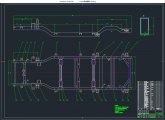
某型SUV底盘车架设计及其强度有限元分析(含CAD图)(任务书,开题报告,文献摘要,外文翻译,论文说明书18000字,CAD图纸7张)
摘 要
汽车底盘车架作为整车的承载基体,承受着汽车自身的载荷和来自路面、车轮各个方向的力和力矩,影响着汽车各个方面的性能,因此,车架结构设计的合理性直接关系到整车设计的成败。特别是对动力越野性要求严格的SUV,对车架的要求更高,所以有必要在车架设计完成后进行强度有限元分析,这对车架的设计和性能校核具有重要意义。
本文针对某型SUV进行了系统动力匹配和车架结构的设计,将CATIA建立的SUV车架三维几何模型导入ANSYS Workbench中得到有限元模型;利用Static Structural模块对车架进行静态分析得到了四种常见工况(扭转、弯曲、制动和转弯工况)下的应力、变形分布情况;利用Modal模块对车架进行模态分析得到了车架自由状态下的前十阶固有振型和固有频率;最后利用Harmonic Response模块进行车架在车轮不平衡激励下的谐响应分析得到了关键点的应力、位移、加速度频率响应曲线和曲线峰值拐点对应频率下的车架整体结构的变形和应力分布。
研究结果表明:车架静力学分析在四种极限工况下的最大应力均小于材料的许可应力,车架静强度符合要求;车架自由模态分析的低阶固有频率避开了地面激励频率、发动机怠速频率等敏感频率区,车架设计合理;车架在两种工况(扭转和弯曲工况)下谐响应分析的最大应力小于材料的许可应力,车架动强度符合要求。本研究为SUV车架的设计和校核提供了一套详细而又完整的解决方案。
关键词:车架设计;ANSYS Workbench;静态分析;自由模态;谐响应
Abstract
Automobile chassis frame bears the auto's own load and the force and torque from all directions of the road surface and wheel, affecting all aspects of performance, Therefore, the rationality of frame structure design is directly related to success or failure of the vehicle design. Especially SUV that strict in power performance and off -road ability attach higher request to frame,So it is necessary to conduct strength finite element analysis after completion of the frame design,which is of great significance to frame design and performance checking.
This paper introduced the system power matching and the frame structure of design for a certain type of SUV; first of all, CATIA software was used to make the three dimensional modeling of frame, and then, it was imported into the ANSYS Workbench software to generate finite element modeling of frame. Static analysis was carried out on the frame using the Static Structural Module, which received the stress and deformation distribution under four common conditions (torsion, bending, brake and turning) ; Free modal analysis was conducted using Modal Module, which received first ten order Modal and Natural Frequency of frame; At last, Harmonic response analysis was conducted under wheel unbalance excitation using Harmonic Response Module, which get the key points of frequency response curve of stress, displacement and acceleration and received the whole frame structure of deformation and stress distribution under the frequency of curve peak inflection point. [资料来源:http://Doc163.com]
The results showed that maximum stress of frame statics analysis under four kinds of working conditions are less than the permitted stress of material, frame static strength meets the requirements; low order natural frequency of frame free modal analysis avoid sensitive frequency area like the ground excitation frequency, engine idle speed frequency sensitive area,etc, the frame design is reasonable; maximum stress of frame harmonic response analysis under two working conditions(torsion and bending) is less than the permitted stress of material, the dynamic strength meet the requirements of the frame design. This study provides a set of detailed and complete solution for SUV frame design and checking.
Key Words:Frame design;ANSYS Workbench;Static analysis; Free modal;Harmonic response
1.3.1 设计初始条件
本文研究的对象是某企业研制的4×4 SUV。其基本参数如表1.1所示:
表1.1 SUV基本参数
全车尺寸/mm 4565×1750×1750 轴距/mm 2725 [来源:http://www.doc163.com]
整车整备质量/kg 1690 轮胎规格 235/75 R15
轮距/mm 1420 排量/L 2.4
最高车速/(km/h) 140 变速器档数 5
最大爬坡度 60% 座位数/座 5



[来源:http://Doc163.com]
目 录
摘 要 I
Abstract II
第1章 绪论 1
1.1课题研究目的及意义 1
1.2 国内外研究现状 1
1.2.1 国外现状 1
1.2.2 国内现状 2
1.3 研究内容 2
1.3.1 设计初始条件 2
1.3.2 研究内容 2
1.4 本章小结 3
第2章 动力传动系统匹配 4
2.1 SUV发动机性能参数的选择 4
2.1.1发动机最大功率及其相应转速的选择 4
2.1.2发动机最大转矩及其相应转速的选择 6
2.2传动系统传动比的确定 6
2.2.1最小总传动比的确定 6
2.2.2最大总传动比的确定 7
2.2.3传动系挡数和各挡传动比的选择 8
2.3 本章小结 8
第3章SUV车架设计及FEA模型的建立 9
3.1 车架概述 9
3.2 SUV车架设计 9
3.2.1 车架结构型式的选择 9
3.2.2 横、纵梁结构型式及联接方式的选择 10
3.2.3 车架基本尺寸的确定 11
3.2.4 车架几何模型的建立 11
3.3 车架模型的简化 11
3.4 SUV车架FEA模型的建立 12
3.4.1几何模型的生成 12
3.4.2 单元类型的选择 12
3.4.3 定义材料属性 13
3.4.4 网格划分 13
3.5 本章小结 15
第4章 SUV车架结构静态分析 16
4.1 静力分析基础 16
4.2 SUV车架强度计算和分析 17
4.2.1 满载扭转工况 17
4.2.2 满载弯曲工况 20
4.2.3 满载制动工况 23
4.2.4 满载转弯工况 25
4.3 本章小结 28
第5章 SUV车架模态分析 29
5.1 模态分析理论基础 29
5.2 SUV车架模态分析 30
5.2.1 车架模态分析的基本步骤 30
5.2.2 车架模态分析结果 30
5.2.3 车架模态分析结论 32
5.3本章小结 33
第6章SUV车架谐响应分析 34
6.1 谐响应分析的理论基础 34
6.1.1 谐响应的分析方程 34
6.1.2 谐响应的分析方法 34
6.1.3 谐响应分析流程 35
6.2 SUV车架谐响应分析 35
6.2.1 扭转工况谐响应分析 36
6.2.2 弯曲工况谐响应分析 39
6.3 本章小结 42
第7章 结论与展望 43
7.1 论文总结 43
7.2 研究展望 43
参考文献 44
致 谢 46 [资料来源:https://www.doc163.com]
上一篇:无人驾驶小车制动系统设计(含CAD图,Creo三维图)
下一篇:重载无人驾驶电动集装箱运输车电驱动系统设计(含CAD图,CATIA三维图)