

基于STM32F103的远程控制系统设计
基于STM32F103的远程控制系统设计(任务书,开题报告,论文21000字)
摘要
智能家居作为当下热门的一项产业,正在不断地改变着人们的生活方式,提高人们生活的舒适度。本文设计的远程控制系统作为智能家居实现的一种简单尝试,旨在更好的应用所学理论知识来实现现实生活中的需要,达到方便生活的目的。
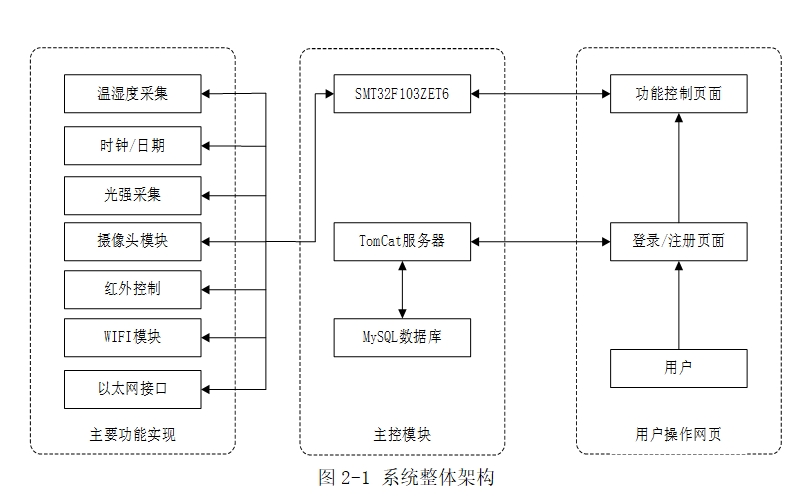
本设计采用STM32F103ZET作为控制芯片,其他功能模块获取外部环境数据并传送数据给STM32主控模块,经过STM32的计算处理后,将需要的信息发送至LCD并上传至网页显示;同时,将STM32战舰开发板作为服务器,发布控制网页。用户服务网页由本地Tomcat服务器发布,实现用户的注册及登录功能。其整体上含有STM32F103ZET6主控模块、DHT11温湿度模块、YS-IR03F红外学习模块、ESP8266WIFI模块、OV7725摄像头模块、RTC模块、光敏传感器、LCD显示模块、内部控制网页、前端服务网页、后台数据库以及其他模块。远程控制系统功能上实现了用户通过外网登录,进入内部控制网页,实现网页和STM32的数据交互。
关键词:STM32单片机 DHT11 红外学习 ESP8266 智能家居
Remote control system based on STM32F103
Abstract [来源:http://www.doc163.com]
As a hot industry, smart home is constantly changing people's lifestyles and improving people's comfort. The remote control system designed in this paper is a simple attempt to realize the smart home. It aims to better apply the theoretical knowledge learned to realize the real life needs and achieve the purpose of facilitating people's lives.
This design uses STM32F103ZET as the control chip. Other functional modules acquire external environment data and transmit data to the STM32 main control module. After STM32 calculation processing, the required information is sent to the LCD display and uploaded to the web page display. At the same time, the STM32 warship is launched. The development board acts as a server and publishes a control web page. The user service web page is published by the local Tomcat server to implement the user registration and login functions. The system function is to enable the user to log in through the external network and enter the internal control webpage to realize the data interaction between the webpage and the STM32.
[版权所有:http://DOC163.com]
Keywords: STM32 MCU; DHT11; Infrared Learning; ESP8266; Smart Home

目录
摘要 I
Abstract II
第一章 绪论 1
1.1 课题研究的背景和意义 1
1.1.1 研究背景 1
1.1.2 研究意义 1
1.2 研究现状 1
1.3 研究主要内容 2
1.4 论文结构安排 2
第二章 远程控制系统的硬件电路设计 3
2.1 远程控制系统的主要功能 3
2.2 系统整体架构设计 4
2.3 硬件模块功能分析 5
2.3.1 STM32F103ZET6主控模块 5
2.3.2 温湿度采集模块 8
2.3.3 时间/日期模块 9
2.3.4 光强采集模块 9
2.3.5 摄像头模块 10
2.3.6 红外控制模块 11
2.3.7 WIFI模块 11
2.3.8 以太网接口 12
2.4 本章小结 13
第三章 远程控制系统的软件设计 14
3.1 软件设计思路 14
3.1.1 软件设计结构 14
3.1.2 整体流程说明 14
3.2 功能程序设计 15
3.2.1 LCD显示模块设计 15
3.2.2 RTC模块设计 17
3.2.3 光敏传感器设计 18
3.2.4 ESP8266模块设计 19
3.2.5 DHT11模块设计 21
3.2.6 OV7725/SD卡模块设计 22
3.2.7 控制网页功能程序设计 24
3.2.8 FlyMcu软件使用 26
3.3 控制网页设计 29
3.3.1 温湿度/时间显示页面设计 29
3.3.2 LED/BEEP/红外控制页面设计 30
3.3.3 摄像控制页面设计 33
3.3.4 网页转换 34
3.4 nat123端口映射 35
3.5 服务网页设计 36
3.5.1 TomCat服务器 37
3.5.2 登录界面设计 37
3.5.3 注册界面设计 40
3.6 数据库设计 44
3.7 本章小结 46
第四章 功能调试 47
4.1 硬件功能模块调试 47
4.1.1 LCD信息显示 47
4.1.2 ESP8266WIFI模块 48
4.1.3 YS-IR03F红外学习模块 49
4.2 网络端口测试 49
4.2.1 控制网络端口测试 49
4.2.2 服务网络端口测试 50
4.3 控制网页调试 51
4.4 结果简述 52 [版权所有:http://DOC163.com]
4.4.1 功能完成情况 52
4.4.2 其他说明 53
4.5 本章小结 53
第五章 全文总结 54
5.1 整体设计构思 54
5.2 问题反思 54
5.3 设计收获 55
参考文献 56
致 谢 58
附录1 MCU部分原理图 59
附录2 硬件实物图 60
[资料来源:http://www.doc163.com]